
Refresher: How Interest Rates Work
A simple one-stop breakdown of how interest rates are determined, and how they affect the day-to-day of the commercial real industry

Mortgage interest rates are the #1 topic of discussion in today's commercial real estate market. Their impact on deals, where rates are headed, and lots of discussion alongside some very strong opinions.
We know most of our clients are experts on how mortgage interest rates are determined, lender's spreads, and how they correlate to a Fed rate change. However, we wanted to provide some useful information for other clients to feel confident discussing rates.
Most importantly: a 25 basis point Fed rate increase does not equal a 25 basis point mortgage interest rate increase.
The interest rate you'll pay on a new mortgage is most closely correlated to the 10-year treasury bond yield, plus a spread, partially due to the fact that 10-year treasuries are the closest duration to the average mortgage length. When the Fed raises rates, they raise their guidance for the Federal funds rate, which is the interest rate at which banks lend money to one another overnight.
The 10-year treasury's rate, while somewhat impacted by the Fed funds rate, is moreso driven by bond investors’ expectations for yields over the duration of the bond (10 years), led by inflation expectations, policies, and overall economic growth.
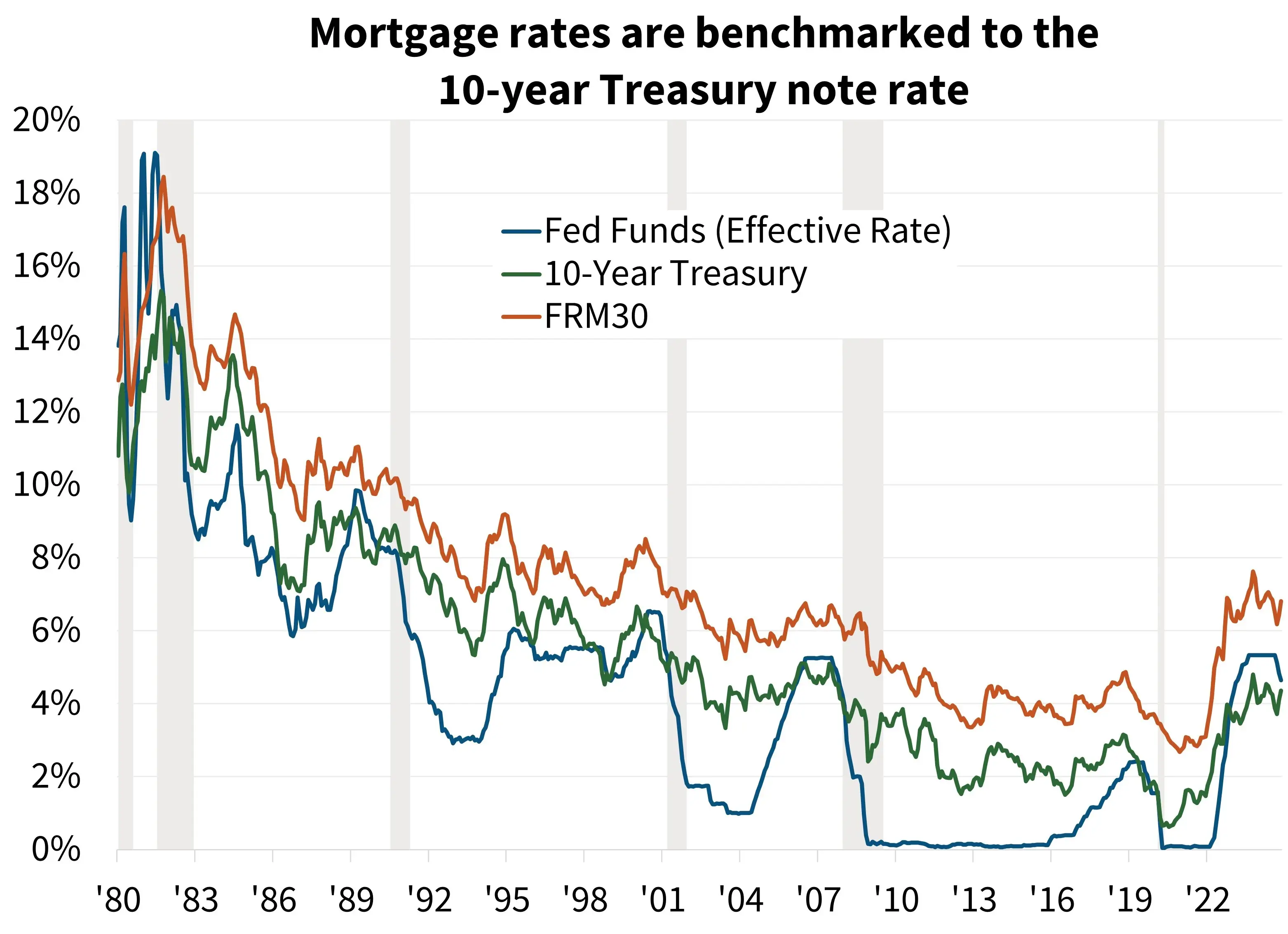
To incentivize banks to lend against real assets instead of simply buying the 10-year, they must be compensated for the additional risk. This is seen in the spread above the 10-year yield.
This spread has averaged roughly between 1.7%-2.0% (varies widely), and can spike above 2.5-3.0% in high-volatility or low-liquidity environments. This spread is made up of the Primary-Secondary spread (mainly made up of servicing fees, actual costs, some profits) and the Secondary spread, which can compensate outside investors like secondary mortgage-backed securities (MBS) investors (representative of real risk).
Now, some banks and financing institutions benchmark their mortgage rates on other sources, like the 5-year treasury or SOFR, and there is much more involved in truly determining interest rates, how MBS markets play a role, etc.
But the next time the Fed hikes or cuts, watch the full treasury yield curve to more accurately predict your next mortgage rate.
Disclaimer: This content is provided for informational purposes only and only reflects the personal opinions of the author. It is not intended as professional or investment advice, or a substitute for consulting qualified experts in tax or law. Always consult your CPA, attorney, and all other qualified professionals prior to making investment decisions. While we strive to present accurate and up-to-date data, we make no warranties or representations regarding its completeness, reliability, or suitability for your specific situation. Always seek the guidance of licensed professionals before making any decisions related to commercial real estate investments or transactions.